
Team Iran in Tijuana
A letter from Mexico

Iran’s brief and frustrating flameout in the World Cup was attended by so much nonsense it might be hard for Americans to grasp what happened. The team was treated poorly by the U.S., as well as by FIFA, and it failed to shoulder out of the group round because of two referee decisions based on an AI-enhanced digital system. Iran’s coach, Amir Ghalenoei, complained about it on TV. Most Americans could not care less. The countries are at war, after all, and there isn’t much precedent for gracious behavior: the 2026 World Cup is the first in history to feature a host nation making war on a guest.
Trump’s government might have tried to show some benevolence to the players, who are not obvious representatives of the fundamentalist government. His war started in a cloud of rhetoric about “the Iranian people,” after all — their suffering under the mullahs, their eventual liberation, or whatever. But Washington went in the other direction.
Until May the team was scheduled to live and practice in Tucson, Arizona. By then Trump and Netanyahu had launched their disastrous war. Because of it, the State Department scoured the Iranians’ visa applications and expressed concern about spies from the Revolutionary Guard tagging along with the players. It denied visas for half of the hundred-odd support staff, which included trainers and medics. Then it denied long-term visas for the team itself, which forced a last-minute shift in living arrangements from Tucson to Tijuana.
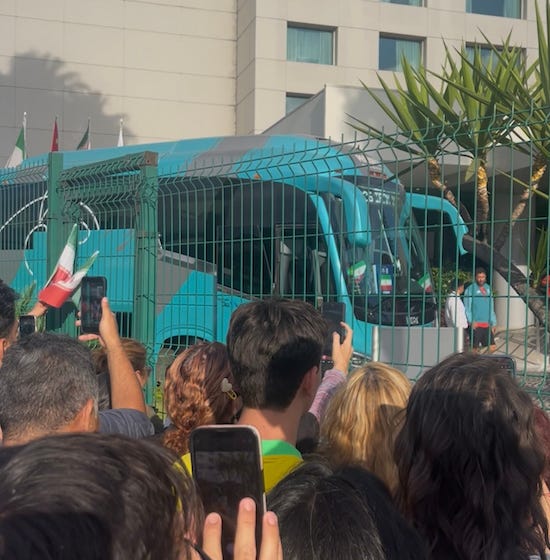
A local club, the Tijuana Xolos, made their stadium available. I happened to be in Tijuana last week as a reporter. Fans gathered outside the Tijuana Marriott every day, whenever the Iran players were scheduled to ride a distinctive blue bus to the stadium for practice, or to the airport for a game in the States. I showed up one afternoon and met a young mother named Claudia, with her lanky sons, holding a tournament ball and a pen. I asked why they were all such fans.
“Because the players are handsome!” she said with a flashing smile. “Very handsome. And because my sons love football.”
“They are our team,” said one of the kids. “The Tehran Xolos!”
No other teams are staying in Tijuana, although Mexico is a World Cup host; so that’s one reason for the excitement. But Mexicans have also heard a century’s worth of excuses and bad logic from the United States about visas and deportation. A taxi driver called David told me the real reasons were “complicated and political.” The seventeen months since Trump’s inauguration were just the head on a very tall glass of beer, he said, and Mexicans have a natural affinity for a team of developing-world players denied entry to El Norte. “We also like to cheer for an underdog.” He smiled and nodded at several red-white-and-green Iranian flags waving along the Marriott fence. “And the national colors are the same.”
It wasn’t a case of raw anti-Americanism — I saw Mexicans cheer for the U.S. during other games — but the underdog factor was important. “We are a border city, and there are people here from the U.S., from Haiti, from all the states of Mexico, people who come to Tijuana looking for opportunity,” Javier Llausas, the Xolos’ team publicist, told me on the phone. “We are very open society. So once we had the news about the training, I think everybody in Tijuana adopted Iran as their second team.”
Could the Iran side have links to the Revolutionary Guard? Sure. Sports in Iran are no less corrupt than in other parts of the world. But the State Department raised a public alarm about exactly one member of Iran’s entourage, who went unnamed, then denied visas to more than fifty. Even that might be understandable paranoia during wartime — but how hard can it be to show some grace to the players? Their short-term visas restricted the team from spending the night after each game before they returned to the Tijuana Marriott. “When you play in a match, physically, scientifically, our bodies are at a low,” said Coach Ghalenoei after the final game in Seattle, “and when you suddenly go on a flight that actually postpones your recovery, and this is the third time they [the U.S. government] are doing this to us . . . Their behavior towards us has been really terrible and we hope the world will be aware of that.”
